


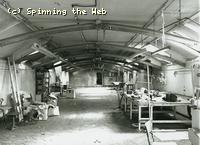
From 1985 to 1989 the Greater Manchester Archaeological Unit and the Royal Commission on Historic Monuments England undertook a joint survey of surviving textile mills and textile finishing works in Greater Manchester. The survey took place out of a general recognition that mills, as the most important class of historic building type in the county, were disappearing rapidly; for instance there were around 2,400 examples recorded on Ordnance Survey maps in the early years of the 20th century, yet by the time of the survey only 1,005 existed. It was important to recognise and protect those mills which best represented the building type; as a result of the mills survey over 90 mills have been listed, affording them statutory protection. The results of the Textile Mills Survey were published in 1992 - Cotton Mills in Greater Manchester by Mike Williams with D.A. Farnie (Carnegie Publishing Ltd). The rationale for the survey is described in the introduction: 'Textile mills have been central features of industrial landscapes in northern and western England for over two centuries. Consequently mills are now perhaps the most characteristic type of historic buildings in many northern towns. In Greater Manchester the prolonged importance of the textile industry resulted in the construction of mills in great numbers. Textile mills and their machinery were the subject of continual development and improvement, so the surviving buildings include a wide variety of dates and architectural types. The early mills included advanced structures which were at the forefront of technology during the Industrial Revolution. The huge scale of mills built a century later reflected both the international importance of the Lancashire textile industry and the extent to which building techniques, mechanical engineering, power systems and production methods had developed. The county of Greater Manchester was created in 1974 with boundaries enclosing what was traditionally known as south-east Lancashire, along with parts of north Cheshire and west Yorkshire. The conurbation included the 'cotton towns' which had grown around the commercial centre of the Lancashire textile industry. Over 2,400 mills and cloth-finishing works were built in an area measuring approximately 25 miles north to south by 30 miles east to west. By the 1980s the decline of traditional industries had resulted in the loss of over half of these mills, while many of the remainder were derelict or awaiting grant-aided demolition. One effect of the widespread loss of mills, however, was increasing public interest in industrial heritage, in mill architecture and in the sensitive re-use of industrial buildings.' The book aimed 'to provide an interpretation of the development of the cotton-spinning and weaving mills, which form over 70 per cent of the extant textile mills in Greater Manchester. Cotton mills in Greater Manchester vary considerably from textile mills in other regions, for example in their size, date range, architectural details and degree of economic specialisation. Readers wishing to make direct comparisons with other areas can refer to the RCHME publication Yorkshire Textile Mills 1770-1930 and the joint publication The Textile Mills of East Cheshire.' The book examined the development of the cotton mill, considered as being dependent on a range of interrelated factors, such as the development of construction techniques, machinery and power systems. An Inventory section examined individual case studies of several key mills from each of the districts in Greater Manchester and finally a Gazetteer listed all the 1005 mills which formed part of the survey, giving information on name, National Buildings Record Number, date, grid reference, economic branch (eg. cotton, weaving, print works etc) and archive category (A for a detailed survey record, B for detailed recording but without written report, C for those recorded in the initial survey and added to the Sites and Monuments Record, and D for those demolished at the time of the survey but mentioned in the text). The Textile Mills Survey is held in three places: the National Monuments Record Centre in Swindon, John Rylands Library on Deansgate and at GMAU's offices in the University of Manchester. At GMAU information on the 1005 mills studied in the survey have been put on the county archaeological database which is called the Greater Manchester Sites and Monuments Record. The archive at GMAU has constantly been updated as mill surveys have been undertaken as part of the planning process, either prior to demolition or to inform conversions of listed mills. Additionally, in recent years the textile finishing industries, including bleaching, dyeing, and printing, have received considerable study as their survival is under great threat, along with associated industries such as engineering, silk manufacture and hatting. Many textile industry sites have below ground remains of archaeological interest, for instance wheel pits, leats, engine house foundations, evidence for early buildings and processes, and these are increasingly being excavated ahead of development to help archaeologists to understand the evolution and character of the textile industry. Examples of archaeological surveys and excavations of individual mills and finishing works can be found on this website along with further information on archaeology in Greater Manchester. At the time of the Textile Mills Survey extant sites were represented across the districts of Greater Manchester as follows: Bolton 143, Bury 140, Manchester 73, Oldham 170, Rochdale 203, Salford 44, Stockport 77, Tameside 116, Wigan 49. It is estimated that today, in 2003, less than 700 mills survive. Norman Redhead View the GM Mill Survey collection to find out more > |
 | |
| Associated Images | |
| |
| Related Narratives | |
| |


