


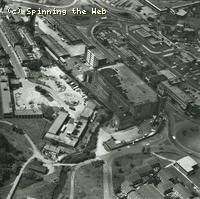
Several water-powered fulling mills are known from the 17th century and these were the basis for the new late 18th century factory system, especially woollen scribbling mills in Littlebrough and Wardle. The woollen industry was so successful that by the mid-19th century Rochdale manufactured 80% of England's flannel production. Water-powered cotton spinning mills were built on the Roch in the 1780s and 1790s, but at late as 1818 there were only seven cotton mills in Rochdale itself. However, by the 1840s cotton had overtaken wool in importance. The new cotton mills were concentrated around the towns of Rochdale and Heywood, the latter having a fine group of ruined water-powered mills in the Cheesden Valley. The growth of the cotton industry stimulated the development of Rochdale town, whose population grew from 8,542 in 1801 to 83,114 in 1901. Heywood's population reached 25,458 in that year. As in other parts of the county the clear river waters aided the growth of bleaching, printing and dying, which in turn led to the development of a textile engineering sector. Lancashire's last firm of textile engineers, Tweedale and Smalley, were founded in Castleton in 1891. However, little now survives of either industry, although the still working Belfield Works of William Tatham Ltd in Rochdale is a notable exception. The woollen trade enjoyed a golden age during the Cotton Famine of the 1860s, when woollens became once more price-competitive with cotton goods. However, cotton remained dominant. The cotton revival was led by the adoption of limited liability cotton spinning companies on the Oldham model from 1882 onwards. Consequently, the town became the second largest centre of joint-stock enterprises in Lancashire after Oldham. But the area also saw the introduction of cotton flannelette production in this period and the continued growth of a significant engineering sector. The success of the cotton industry at the end of the 19th century and into the 20th century is reflect in several groupings of late mills in Heywood and Rochdale and included some of the last mills to be built in the county at the Dunlop Mills complex (erected 1914-19). The success of Rochdale's textile industry in the 19th century led to its rise to borough status and it remained the dominant settlement, despite the growth of the industrial towns of Heywood and Littleborough. During the 20th century Rochdale's spinning capacity declined more slowly than that of any other town with the exception of Wigan. This contrasted sharply with the decline of the Heywood cotton mills in the same century, which was only exceeded by those in Glossop. However, the town also had one of the first mills to be listed; Crimble Mill, which was protected in 1967. (source: R. Mc Neil and M. Nevell (2000) AIA Guide to the Industrial Archaeology of Manchester) BB View the Rochdale collection to find out more > |
 | |
| Associated Images | |
| |
| Related Narratives |
Rochdale Towns |
| |

| 
| 
| 
| 
| 
|


