


Making Cotton Learning Journey
Cotton is not made; it is a plant which grows in warmer parts of the world. Cotton plants have yellowish pink flowers which bloom very briefly. The seed bearing part of the plant is known as the boll and it is this which is picked to make cotton. For thousands of years cotton has been harvested, cleaned, spun, woven, bleached and dyed to make an astonishing variety of different items.
Click on the steps below to learn about cotton through history, cleaning and carding, spinning, weaving, bleaching and dyeing.
Click on the steps below to explore.
 |  |  |  |  |  |
|
Making Cotton Learning Journey Step 3: Spinning
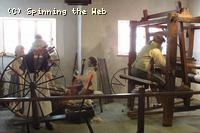
Later drop spinning was introduced. This was done with a spindle (tapered wooden stick) with a whorl (weight) at one end to help it spin. The spindle would be rolled (probably against the leg) to twist the fibres and the weight on one end would help to stretch them. The bead-whorl spindle was 'specifically designed to spin fine yarns which require a lot of twist and was in widespread use throughout Asia, the Middle East and Africa where short staple fibres such as cashmere, cotton and camel were used' (Heather McCloy, 2000). Distaff spinning was done by holding (usually) long staple fibres, such as wool and flax, on a comb or in a cleft on a distaff (wooden stick) which was held by the left arm while the spindles and yarn feed were worked with the right hand. Spinning wheels are the best known tool for spinning. The Great Wheel, developed for spinning yarns (including cotton) in India around 500 B.C. was the first to have a mechanised spindle. There were spinning wheels in Persia in by 1257 and in China in 1270, but they were not in general use in Europe until 14th century when the Saxony Wheel, which used a foot pedal to turn the spindle, was introduced in Germany. Spinning (or spindle) wheels could spin without so much pulling and twisting of the fibre which produced a softer yarn but it was not as strong. Very little cotton yarn was spun in England because of the length of time it took. The spinning jenny, invented in 1763, could initially spin six threads at once, instead of just a single thread. This was later increased to 14 threads. The spinning mule however could spin multiple threads that were of suitable strength for both warp (threads running down the weave) and weft (threads running across the weave). After these last two developments cotton spinning became a major industry in Lancashire. Timeline drop spinning Neolithic (c8,000-5,000 B.C. [2,500 B.C. in England]) distaff spinning Medieval (c A.D.1066-1478) spinning wheels 500 B.C.(India) A.D.1400s (Europe) spinning jenny A.D. 1763 spinning mule A.D. 1779 See also on this website: Industry: machines and processes - spinning Contact Quarry Bank Mill at Styal in Cheshire for a tour of a working mill and information on spinning courses 01625 527468 |
 | |
| Associated Objects | |
| |
| Related Narratives | |
| |


